by Nina Ferrante and Anna Rispoli_Struggle Care Joy
Struggle Care Joy is a trajectory shared by several grassroots collectives of women* in exile, aiming to move forward together in the struggle for regularization and toward personal emancipation. Today, the trajectory includes the Comité des Femmes Sans Papiers, Femmes Tout Terrain, and Candidates Sans Papiers from Belgium; Territorio Doméstico and Comisión Antirracista 8M from Spain; and a number of autonomous union organizers from France.
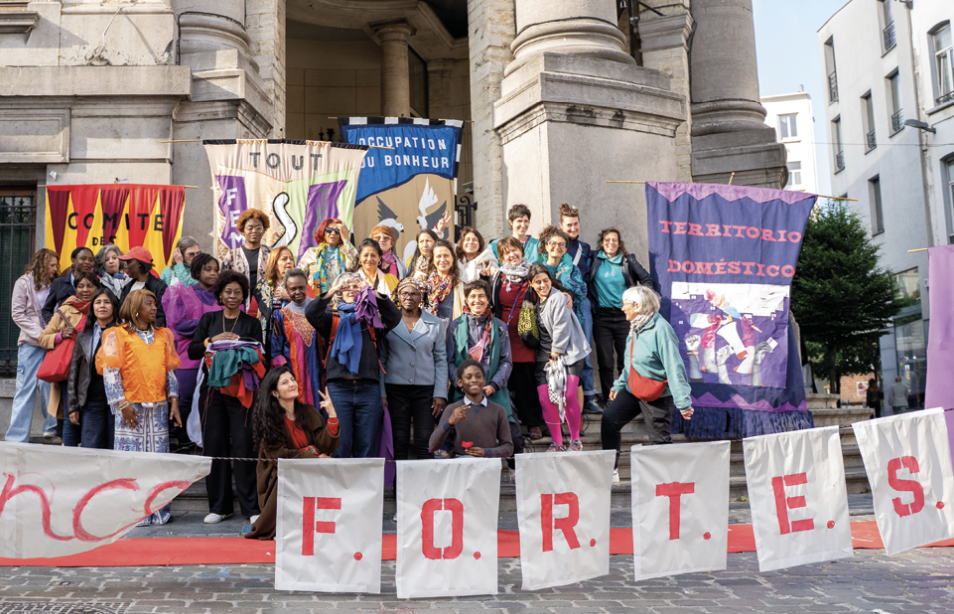
The use of artistic strategies grounded in the prefigurative practice towards desirable futures – futures that are today more urgent and essential than ever – has given rise to electoral campaigns, antifascist fashion shows, performances in public space, and, above all, the ALLIANCE DES FORTES (Féministes Organisées Résistantes Transnationales Exilées et Sorores), a collective subject that aims at positioning itself on the European stage as a counterforce to the project of the racist right.
Struggle Care Joy has kept us in motion for over a year now, ever since Anna brought us into this project of sisterhood and active complicity between women* with and without documents. We call this practice of doing-together a trajectoire: not a straight line, but a posture – an attitude of looking ahead, beyond the swamp of the present, past the boundaries of what can be imagined today, and further than what we have done so far.
This is how we define the practice of prefiguration – not as a wishful hope that naming something will make it come true, but as a steady cultivation of faith in utopia, a political commitment to bringing forth what does not yet exist, without any longer postponing to the future the transformative capacity of the collective.
Since we started, everything has accelerated, veering sharply to the right: the European Pact on Migration, the genocide in Palestine, war becoming the only horizon, the rise of the European far right and global fascism. In this conjuncture, turning toward the future feels like an even more radical act. The exercise of prefiguration demands that we stay grounded in urgency while already organizing the infrastructures that allow us to persist, to resist, to sustain each other, even as we’re still formulating the question of who “we” are when we speak as one, and – most of all – which networks we can rely on when one of us needs time to breathe, space to feel safe, to come back to herself, and regain the strength to move forward.
The asterisk in women signals an inclusive usage of the term, referring to all those affected by patriarchal oppression and/or socialized as women, regardless of gender identity. It is a political and intentional choice rooted in intersectional and transfeminist feminist frameworks.
We are writing from Brussels, the symbolic capital of a Europe that claims unity through a supposed identity project, rooted in colonial history and propelled forward by warfare, bordered by frontiers that constantly manufacture an enemy to defend against. As we build our trajectory, we have come to understand the symbolic potential of this city, which we hope will become, on our own maps, the beating heart of an alliance emerging from the burning margins. «Porque sin nosotras no se mueve el mundo», as our compañeras from Madrid say.
Focusing on each of the terms through which we build our shared practices, we recount the actions of a collective journey as an invitation to what we can still do:
#care: we continue to invest in the material value of care
#joy: we invent the priorities of a community led by a Candidate Sans-Papiers
#struggle: we inaugurate a transnational alliance against the Migration Pact
#CARE (May 2024)
The compañeras of Territorio Doméstico – a transborder collective of immigrant women based in Madrid – arrived dancing, their songs already a political program. One of the women ready to welcome them, from La Ligue des Travailleuses Domestiques, part of the CSC/Brussels union working with migrant domestic workers, told us she immediately thought: Something is about to happen here.
And so began four days of deep reflections, joyful dancing, tears of emotion and uncontrollable laughter – a school about the politics of care, hosted by KunstenFestivalDesArts, where we discussed reproductive labor from the perspective of migrant women within patriarchal and racist societies.
“You’re like family” is the master’s magic formula: considering the emotional blackmail of unpaid labor, something all of us socialized as women know too well. But there’s something in that “like family” that reveals a deeper truth: some women will never be accepted into the family, because in the Father’s house and in the Homeland, they remain foreign, undocumented, and even more vulnerable to exploitation within domestic walls.
We were guided in this reflection by Lea Melandri, Maddalena Fragnito, and Silvia Federici, who helped us unravel the knot that binds the emotional ambivalence of intimate relationships to the violent matrix of colonial exploitation within global reproductive labor chains.
The workshop on tools of struggle led by Territorio Doméstico consisted in re-situating one’s personal experience within the framework of a collective narrative of oppression – and, at the same time, in feeling the emancipatory power of collectivization and reappropriation through
action-theatre.
This is how figures like La Perra Liberada (the Unleashed Dog), an archetype of the woman who breaks away from exploitation, came to life; along with La Pulpo, a multitasking heroine, and La Empoderada, who proudly claims her right to an aperitivo with her friends.
These archetypes joyfully took over the public space of KunstenFestival with a Pasarela – a subverted fashion show – claiming visibility, but above all occupying space and asserting the agenda of those who are usually left out of moments like these.
#JOY (September 2024)
A new chapter begins – new first of all in its composition: our network of comrades expanded to include other self-organized groups of women without papers. Among them, the Comité des Femmes Sans Papiers and the women from Occupation de la Paix. Over these months, we have become implicated in one another’s lives – facing evictions together, opening new homes, and forging new bonds of sisterhood with other allied collectives.
We came together again at Kaaitheater to pick up the thread we had left, gathering around the question of care and the phrase: “with love, not for love.” While the workshop was unfolding, the municipal elections were taking place all around us – when migrants disappeared from political discourse (especially women), only to be invoked by racists in the name of security.
What better time to imagine what city administration would look like if care were placed at the center? What if the city were made livable starting from the needs of the most fragile? Who better than an exiled woman with no access to housing could manage a housing crisis? Who would be more capable of rethinking anti-violence measures outside of securitarian logic? Who better than an undocumented person could redesign the integration of services and a centralized regularization system without administrative dead ends?
That’s how the public action during MolenFest 2030 was born, on the Pont des Flandres: launching the first Candidate Sans Papiers. The campaign poster was a cut-up of the faces of many of the women who initiated the project, a vision greater than the sum of each one’s intelligence, the project a glimpse of what we could build if we weren’t constantly being drained by survival.
To prepare, we focused on occupying public space, on legitimizing the right to speak for those usually excluded from politics, on the embodiment of visible, proud bodies that take the stage in a celebration of the city to come.
#STRUGGLE (May 2025)
Against the European Pact on Migration and Asylum, we made ourselves an Alliance. Everything around us moves quickly – and to the right – amplifying the sense of precarity. Belgium elects the “Arizona Government,” a broad coalition whose first agreement is to cut social rights and actively persecute migrants. Europe elects a new majority, again leaning further to the right, fronted by the reassuring face of a woman – Von Der Leyen – who made it clear that from now on, war
would be the only item on the agenda.
In this context, turning toward the future feels even more urgent, more radical. Europe is rearming, building unity by constructing borders that for many represent the line between life and death. It arms wars and genocide in Palestine, exploits and pollutes while refusing to welcome those whose lives it has rendered unlivable.
To this Europe, we say: you will find a united front of women – more powerful than ever, because we are organized. Nothing terrifies power more than that.
We gathered in Brussels to speak directly to the heartless heart of European politics: we are ready to write a new history – or rather, new futures – feminist, anti-racist, anti-fascist, and without borders.
We invited Territorio Doméstico to join the Alliance, and other compañeras arrived from Spain, France, Italy – care workers, community-builders, trade unionists, squatters, singers, artists. All militants.
During three intense days of meetings held at Kanal, we took care of each other, we developed a shared strategy for struggle and a common horizon of freedom and joy. We discussed practical issues: mutualism, self-organization, and self-funding of our movement. We refined a plan to be more effective:
“Face à la criminalisation des personnes migrantes, nous voulons dire d’une seule voix que nous sommes celles qui luttons pour la vie.”
As the comrades from Comité des Femmes Sans Papiers often remind us:
“Nous ne sommes pas un danger, nous sommes en danger. That’s why we unite.”
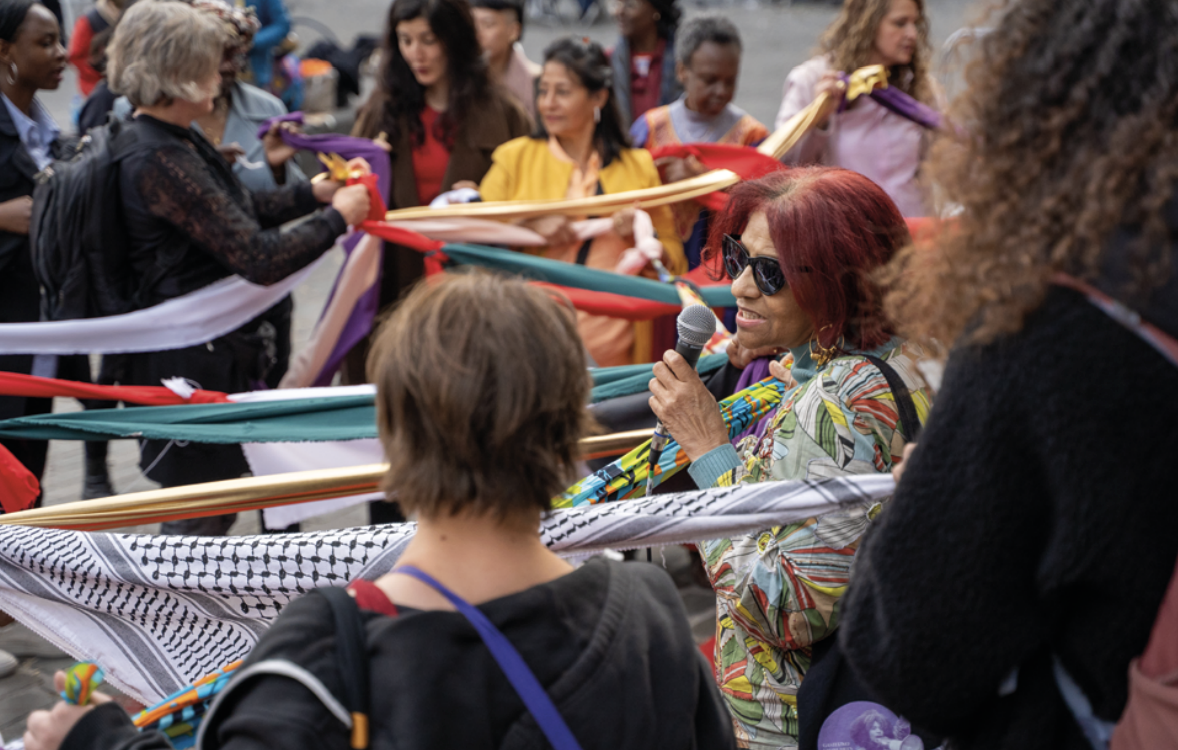
We created and brought into the streets a ritual to give visibility and weight to the pact we were forging with one another. Our alliance is not written on paper, it is not expressed through legal language, it is not based on violence or fear. Our bond is inscribed in our bodies, it is made collective in a moment of joy and struggle in Molenbeek’s square—making visible the creative, transformative force of our practices in public space.
The best is yet to come.
A trajectory, as we said, is defined by its ability to keep looking beyond what already exists. To form an alliance is, above all, an act of trust – not only in the relationships we already have, but in those yet to come.
We are building a political platform, a space of exchange between migrant women, to break out of the isolation into which migration policies try to enclose us. We now have a shared calendar of coordinated actions, a promise of wide mobilization whenever one of our nodes is under attack, and an infrastructure for exchanging the best tools from a shared toolbox of resistance.
What matters most to us right now is understanding who we are when we say “we”:
Which new collectives want to join the alliance?
What practices are still unknown to us that could expand the transformative potential of our actions?
Who are the protagonists?
What is the space for supporters of the alliance?
How do we support an alliance by redistributing material resources and social capital without taking up the space of those most directly concerned?
In the difficult times ahead, we need to know that it is within our shared struggle that we will find our strength.
To become more visible, more effective, and more connected internationally.
The best is yet to come.