by Sara Badri & Valerii Saenko
As migrant academics in Europe working on migration, we recognised the persistent need to talk about migrants’ lived experiences inside European universities. In response, we organised a seminar and a follow-up workshop as a collaborative inquiry into precarity, policy, and possibility, titled: From Lived Experience to Theoretical Frameworks: Rethinking Academic Migration. The seminar brought together migrant academics from various European universities, mainly non-European scholars, who discussed their research on the topic and anecdotes from their own experiences navigating European academia. The purpose of the event was to situate migrant academics’ experiences within European institutions through examining precarity, mobility regimes, epistemic injustice, and emotional labour, amongst other draining challenges. The workshop was a necessary intervention to address gaps within the system.
The workshop, facilitated by us as the authors of this piece, extended these conversations in a more intimate setting. Over three hours, nine migrant academics at different career stages gathered to share reflections on precarity, policy, and everyday academic life. We designed this workshop with the intention to serve a dual purpose: gather reflections and apply an anti colonial anthropological approach, to emphasise care and mutual recognition. By positioning ourselves as internal critics, we collectively researched our own tribe, working with migrant academics as migrant academics1.
The workshop opened with an icebreaker activity. During the introductory section, keywords were collected while participants shared their reflections. They built on each other’s thoughts and illustrated their ideas on interpretive posters. In this article, we draw from the themes discussed during the workshop: symbolic desirability, performative inclusion, epistemic injustice, gaslighting, resilience, anti-migrant bureaucratic systems, and other depleting challenges. This piece emphasises that embodied knowledge generates theory from lived experience, presenting alternative ways to move this unlearning debate forward.
Setting the Scene from Lived Experiences
Migrant academics often embody an ironic institutional paradox; symbolically desirable yet epistemically inconvenient. Even attending to their bureaucratic needs is often perceived as burdensome by institutions. Their difference is framed as a resource, but also as potentially disruptive. Diversity is desired, yet contained, not accommodated, engaged with, or genuinely encouraged; in fact, feared in some cases. In this context, diversity in academia can be performed symbolically by institutions for prestige, legitimacy, or EU funding. Performative inclusion2, therefore becomes a form of reputational capital, enhancing institutions’ moral and global standing without reconfiguring material power structures. Performative inclusion is often evident in the use of diversity buzzwords in mission statements and tokenism, while systemic biases remain unaddressed3. This performance also extends to hiring practices, superficial events, and diversity committees that fail to produce actionable internal policies for shared power, influence, and epistemic justice. Migrant academics’ difference is courted for its aesthetic and symbolic value, yet carefully policed to prevent epistemic or structural disruption.
Epistemic injustice⁴ has a significant impact on migrant academics’ personal well-being and careers. Their credibility and legitimacy as scholars are continually called into question. This is rooted in hermeneutical injustice5 whereby dominant narratives ignore marginalised experiences or cast doubt on their competence. It also manifests as epistemic exploitation, for example, when migrant academics are expected to translate cultures, languages, and act as gateways to entire regions. Migrant academics are also expected to serve as the primary explainers of their own injustices; this article and the prior workshop are clear examples of such additional labour. As their credibility is questioned, curriculum erasure ensues. Consequently, their knowledge and contributions are excluded from or misrepresented within dominant Eurocentric frameworks. This, in turn, leads to silencing or perhaps the managed containment of epistemic plurality. Institutions fear epistemic disruption: intellectual traditions, methods, or critiques that might destabilise Western or neoliberal norms. Thus, a managed differences approach is produced, one that sanitises diversity to make it more palatable, which leads migrant academics to self-censor as a habitual response. This process is also described as epistemic domestication; that is, becoming the non-threatening grateful immigrant.
The Body is Data
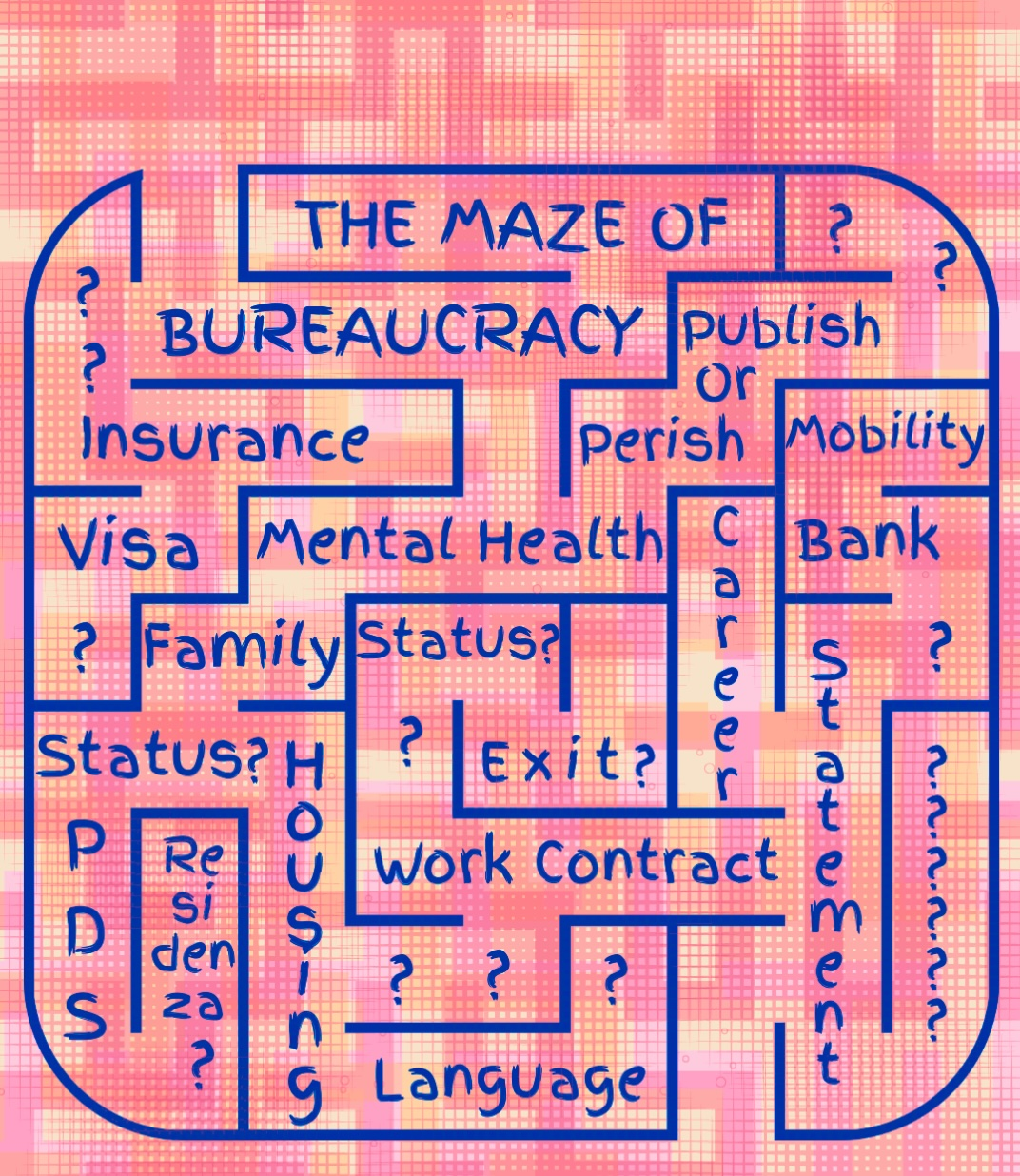
A pervasive exhaustion emerges from the constant bureaucracy, institutional epistemic violence, exploitation, and the continuous navigation of precarity. One scholar captured this infuriating condition by stating “I’m not coming into your space; you make the effort.”, underscoring the one-sided, draining demands of bureaucratic and neoliberal academic structures. Within this landscape, the foreign body, frequently cast as alien, is expected to absorb greater hardship and is routinely denied empathy. The precarities that accompany migration are framed as the migrant’s own choice, summarised in the implicit injunction “he should have known better”.
Rather than reproducing the strands of dominant literature that alienate migrant bodies, flatten and silence their perspective, we foreground migrants’ embodied experiences as crucial sites of knowledge production. Therefore, the following section provides insights into how centring views of the migrant body challenge notions of objectivity and institutional erasure of emotional and bureaucratic harm. One participant speaks of the body as a map, a guiding instrument that is also defiant. After navigating a suffocating system for many years, her chosen illustration during the icebreak session reads: “Do not come close. If you touch me, I have spikes and will use them against you to protect myself.” This reflects a form of impostor syndrome, she explained, not in the sense of intellectual inadequacy, but in terms of social non belonging and a need for a support system. Another participant embodies the figure of one who is powerful, knowledgeable and burdened, yet presents himself with gentleness and a non-threatening demeanour: “I go to the post office and tell them, io bello, haha, I am not a threat…” His primary defence mechanism is pre-emptive justification in response to an assumed threatening presence and ongoing marginalisation; a dynamic he experiences as deeply frustrating.
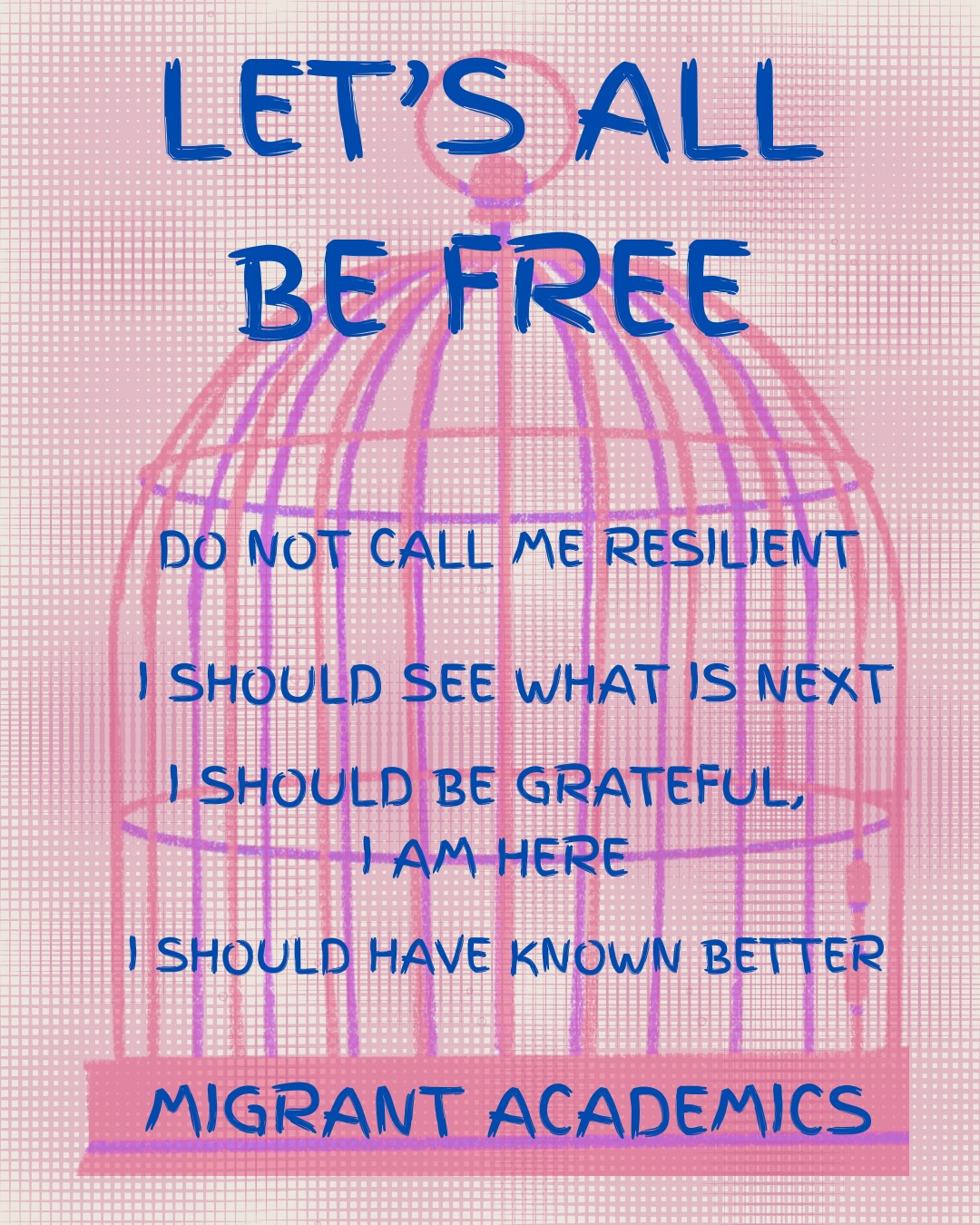
Resilience is routinely demanded of migrant academics: how much can you carry, and why can’t you carry more? The term resilience has been weaponised against marginalised groups, including migrant academics. They are expected not only to be resilient but to exhibit a grateful resilience. Demonstrating an exceptional capacity to bear and navigate additional burdens to prove their competence and justify their presence within an institutional environment clearly not designed with them in mind. Institutional expectations are sustained through a romanticisation of resilience that forecloses space for envisioning alternative conditions. Resilience is not simply encouraged; it is normalised as a core requirement, embedded in the narrative that surrounds migrant academics’ lives. “Don’t Call Me Resilient”, one of the interpretive posters exclaimed. In response, there is a need for a conceptual framework that calls for less resilience and more acts of resistance. Such a framework would also shift the burden of adaptation by demanding greater resilience and responsibility from those occupying dominant positions within the academy.
Gaslighting⁶ emerged as another central theme in participants’ reflections. They described intolerable, traumatising exploitation, suffocating bureaucratic demands, and relentless expectations placed on the migrant’s body and mind. Conditions that make rest and rejuvenation essential rather than well-earned. These harms are intensified when migrants’ lived experiences are not recognised as knowledge, but instead are repeatedly questioned in ways that imply they themselves are the problem. That they should have known better, worked harder or held the “right” papers to make things easier for the institution. This logic only compounds violence. Their circumstances are, in fact, produced and constrained by the very structures that frame these difficulties as individual failings rather than systemic violence.
Expectations and Practice
Much is expected of migrant academics entering the world of higher education and research in the EU context. As mentioned previously, migrant academics are often presented as part of the positive virtues of institutions and countries. Reflecting the breadth and depth of EU institutions’ acceptance of foreign visions or presenting institutions as spaces of many opportunities for migrants.
In relative terms, the presence of migrant academics at a university or a country is already a major step. There are relatively few spaces that consider facilitating migrants. Academia in the EU is one of those spaces. In absolute terms, this picture is somewhat misleading. Formally, universities are not responsible for migrant academics’ success in obtaining the needed paperwork, e.g. residence permits, or lack thereof. Nor are institutions responsible for academics’ ability to travel for fieldwork, participate in conferences or other activities. The migrant academic alone is responsible for preparing and obtaining all the legal foundations for equal opportunities as the EU colleagues.
This burden is the foundation of the pervasive exhaustion of migrant academics. This work is expected with partial support from universities. As one presenter from the seminar mentioned, the support from universities is highly differentiated, often connected to the academic’s background. There is a fi ne line between what the university is responsible for in terms of supporting migrant academics’ bureaucratic struggles and what the staff can actually facilitate. These are often not clearly outlined responsibilities and become, in essence, care work that staff members are morally inclined to do. Yet such work is often outside of their clearly defi ned duties, and staff do not always have the capacity for it.
This often results in individualised help based on individual relations between the staff members and academics. It relies on whether the migrant academic and the staff member have the capacity to find solutions together. The atmosphere of informality, while it has its traditional and useful sides, unfortunately fails to address the systematic problems faced by all migrant academics. A single request from the university’s international office to the migration police headquarters can successfully expedite bureaucratic processes. Yet there is no system of accountability in the event of failure.
Migrant academics cannot hold the university fully accountable for their difficulties in navigating bureaucracy to ensure their “legality”. Universities, as well as migrant academics, have very limited channels to hold the state accountable for the anti-migrant bureaucratic system. Migrant academics expect the university to facilitate the same opportunities as
those available to native and EU academics. Universities expect migrant academics to deal with much of the legal and cultural burden themselves. In practice, both end up doing extra work that distracts them from their core roles.
Essentially, European universities are embedded within a specific system where they often depend on state and/or EU funding to continue their operations. A major part of such funding is the requirement for internationalisation. It brings prestige and funding under the ideals of knowledge and brains crossing borders into the host country. At the same time, the policy of host countries, especially in recent years, drifts towards stricter migration regulations, quotas, control over what constitutes a high-quality expert, and threats of deportation in case the migrant speaks up against the host country’s policies.
This puts the requirement on universities to bring in international minds, yet it does not create opportunities for structural shifts that help universities facilitate their arrival. As a result, responsibility and burden for such facilitation are shifted from the host country and university to the guest. It becomes the guest’s responsibility to figure out how to stay and thrive in a potentially hostile host environment. All while the host university is limited by jurisdiction and the individual capacity of the internationalisation office’s staff. Both lack the capacity to introduce systemic change and sit only in the space of changing their internal procedures.
Collaborative Reflection
The collaborative workshop functioned as a space of collective sense-making, methodological intervention, and practice of group introspection. Through its emphasis on shared authority over authorship, agency, meaning, and above all, mutual vulnerability, it models horizontal forms of facilitation. Within this framework, researchers acted as facilitators of a safe and prolific environment in which both participants and researchers contributed to and engaged with every phase of the process. Considering the heaviness of the themes discussed, participants variously described the workshop as therapeutic and healing, noting that it brought them closer together and generated a sense of joy, highlighting collegial solidarity and support systems.
We found that the shared positionality between researchers and participants shifted power dynamics. This shift affected the kind of data generated and how that data can be mobilised, interpreted, and narrated. Participants’ emotions and experiences were acknowledged, reflected upon, and mirrored back. Precisely because participants and facilitators shared closely aligned, perhaps often identical experiences, the space enabled forms of recognition not typically available in more conventional research settings. Essentially, this intentional methodology demonstrates that data is situated within and between the researchers and participants. In this sense, the workshop drew on a deeper, introspective, embodied knowledge that could only surface through shared experience and a carefully designed atmosphere of trust, co-produced by researchers and researched-with7.
- Patricia Hill Collins, Learning from the outsider within: The sociological significance of Black feminist thought, Social Problems, 1986.
- Sara Ahmed, On Being Included: Racism and Diversity in Institutional Life, Duke University Press, 2012.
- Gayatri Chakravorty Spivak, Can the subaltern speak?, In C. Nelson & L. Grossberg (Eds.), Marxism and the interpretation of culture, University of Illinois, 1988.
- Epistemic injustice is the harm that occurs when social prejudice unfairly diminishes a person’s credibility, understanding, or recognition as a knower. Miranda Fricker, Hermeneutical Injustice. In Epistemic injustice: power and the ethics of knowing, New York: Oxford University Press, 2007.
- Kristie Dotson, A Cautionary Tale: On Limiting Epistemic Oppression, Frontiers: A Journal of Women Studies, 2012.
- Paige L. Sweet, The Sociolog y of Gaslighting, American Sociological Review, 2019.
- Linda Tuhiwai Smith, Decolonizing Methodologies, (2nd ed.), Zed Books, 2012.