by Nicoletta Alessio

On November 1–2, 2025, the Network Against Migrant Detention—a coalition of Italian and Albanian organizations united in opposing the Rama–Meloni agreement—gathered in Albania for a two-day mobilization. The agreement has enabled the creation of two migrant detention centers in Albania under Italian jurisdiction. This was the Network’s second largescale action, following the December 2024 protest when the centres were still empty.
This year’s protest, launched under the slogan “From Albania to Europe: Abolish Migrant Detention Centers,” drew participation from around ten EU and non-EU countries. Representatives from Nantes, Brussels, Bilbao, Dresden, Berlin, Vienna, Pristina, and Mexico joined Albanian and Italian groups to learn more about the agreement, discuss its implications, and explore potential joint initiatives.
“Everywhere—from Gjäder to Rome, from Brussels to Nantes, from the U.S. to Mexico, to Libya, Tunisia, and beyond—we want the same thing: freedom of movement and dignity for all” reports the Network’s political statement on the mobilization¹.”
The mobilisation followed the Network’s established two-day format: a public demonstration followed by political discussions through panels and assemblies.
On Saturday, November 1, over 150 people marched through the streets of Tirana, stopping at the Albanian Prime Minister’s office, the Italian Embassy, and the EU Delegation to Albania to denounce the agreement. A large banner depicting Meloni, Rama, Trump, and von der Leyen dressed as prison officials accompanied the protesters, alongside another that denounced: “Europe preaches democracy but embraces autocrats.”
“Rama maintains his grip on power through close ties with these figures, signing an illegal agreement with Meloni that the European Union quietly approved. It’s precisely this silence from the EU that we cannot forgive,” said Edison Lika from Mesdhe, the Albanian collective that organized and hosted the mobilization.
Rama faces mounting criticism from Albanian civil society, which describes its country as a democracy only on paper. Financial and political dealings remain opaque, while civic participation is stifled by repression—both the lingering legacy of Hoxha’s regime and today’s subtler forms of punishment, such as firings at work or the suspension of meager pensions for relatives of troublesome activists.
The march concluded at the gates of the Gjäder CPR (Repatriation Detention Center), where participants commemorated the forty-seven people who have died in Italian CPRs, expressed solidarity with the 24 currently detained individuals by chanting “You are not alone,” and displayed a massive banner directed at the above mentioned leaders depicted as guards:
“Your Remigration Prisons Are Criminal. Stop Funding Wars and Deporting People!”
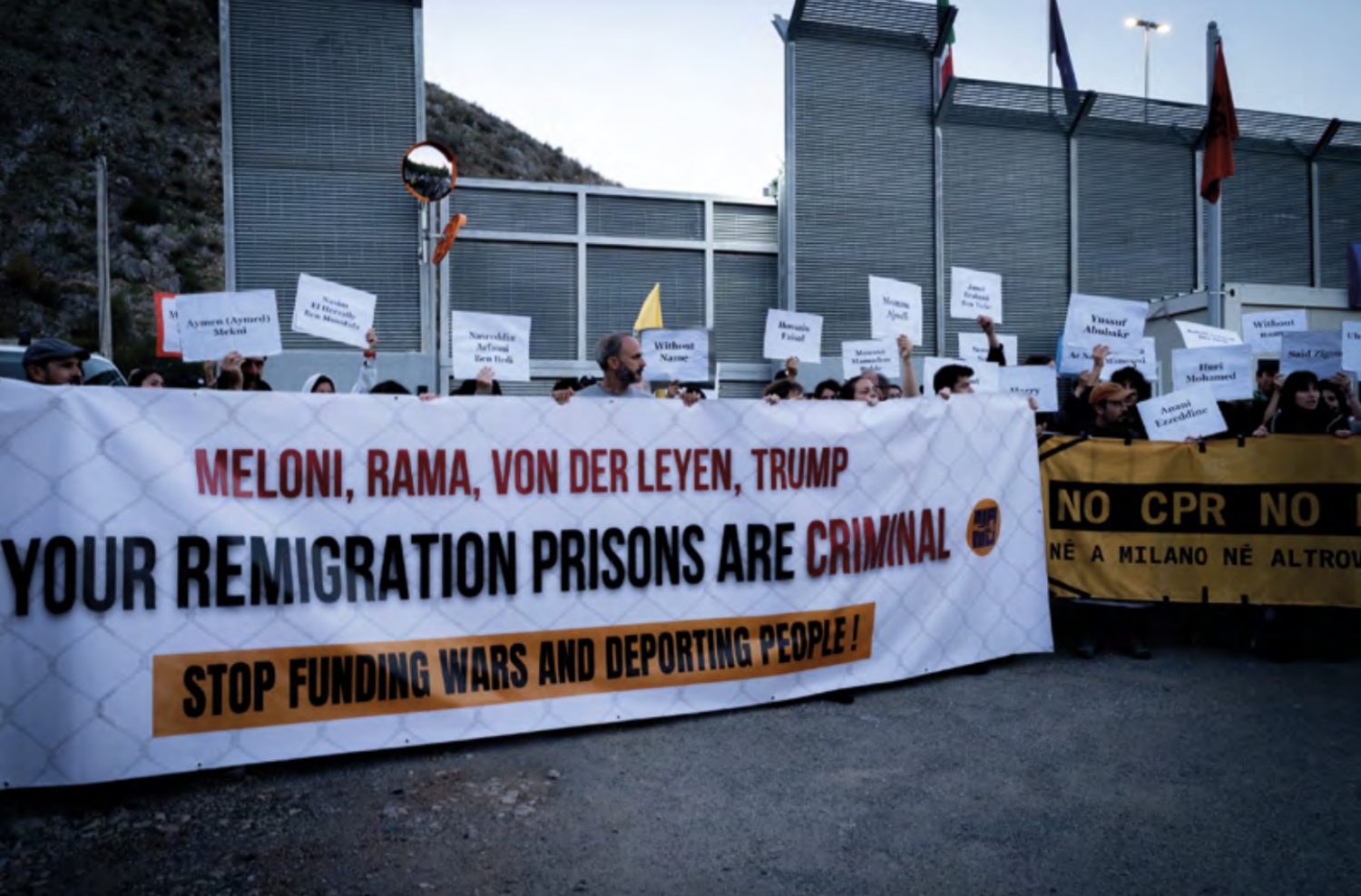
banners outside of the
Gjäder CPR
© Alessandro Murtas
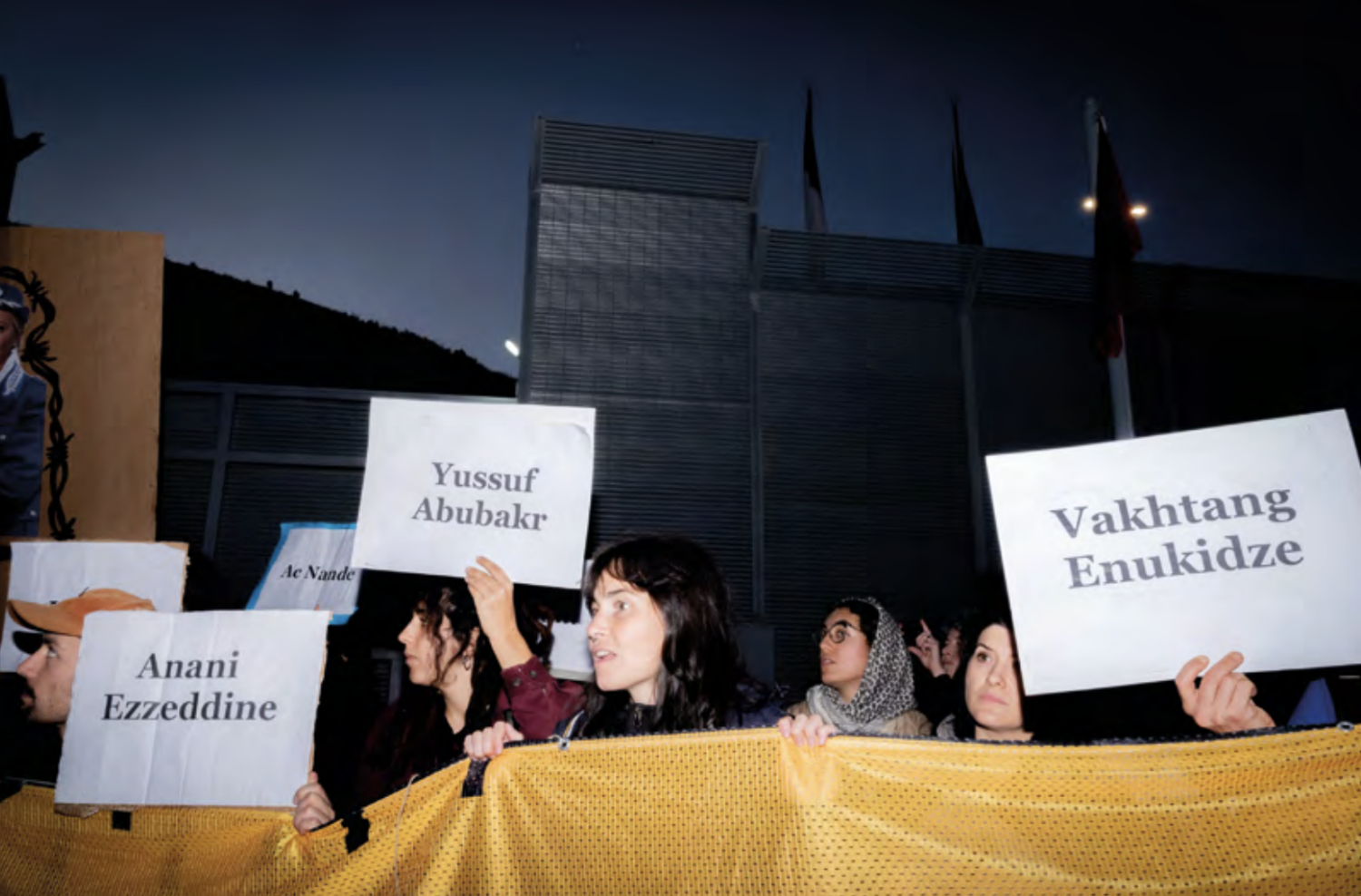
the names of victims of
Italian’s CPR
© Alessandro Murtas
On Sunday, the University of Tirana hosted a transnational assembly bringing together activists from across Europe and beyond. Discussions focused on racism, colonialism, and the broader meaning of the Italy–Albania agreement within European migration policy. The event – organized by Albanian activists and lecturers who titled it “Is Europe Still Our Dream?”— highlighted how EU membership has repeatedly been conditioned on violence at its borders.
“In 1998, Giorgio Napolitano declared that if the CPTs [former CPR, Ed.notes] hadn’t been established and the Kater i Rades shipwreck hadn’t occurred, Italy wouldn’t have been able to prove to the EU that it could defend its borders,” said Clara Osma, an activist with Mesdhe and Italiani Senza Cittadinanza, outside the gates of Gjäder.
Meanwhile, in France, groups from the Anti-CRA Network organized a solidarity action in Nantes to coincide with the Tirana mobilization.
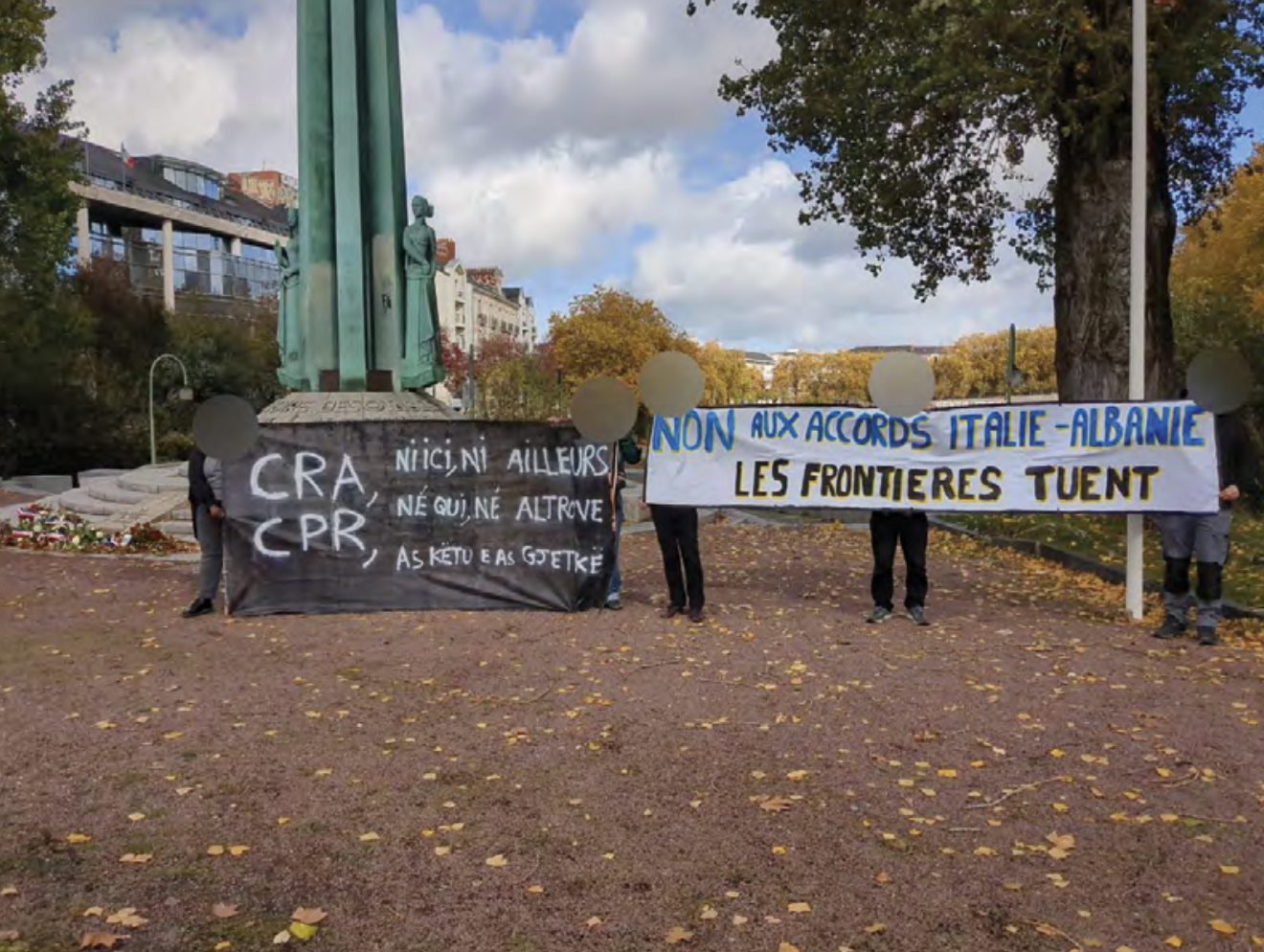
solidarity with the protest
in Albania
© anticra44 instagram page
Some activists who were meant to travel to Albania instead disembarked from their Bologna–Tirana flight after protesting the presence of police officers carrying out the deportation of two Albanian citizens on their Ryanair plane.
The detention centers in Albania are far from operating as the Meloni government had envisioned. The Shëngjin hotspot remains empty, while the Gjäder CPR holds around twenty
people at a time,despite a total capacity of 880. Yet the activists within the Network stress that the agreement has already had unacceptable consequences: over 220 people have been detained, and one man, 42-year-old Hamid Badoui, has died.
Despite this, the Meloni government has allocated €670 million of Italian taxpayers’ money to build and maintain the centers. More than €127 million of that sum comes from cuts to public ministries—including the Economy and Finance, Foreign Affairs, and University and Research ministries².
These funds do little to boost the local economy; instead, they mainly cover construction, maintenance, and staffing costs. Only about fifty Albanians are employed at the centers—as precarious workers for Medihospes, the Italian company managing the Gjäder CPR and one of the giants of Italy’s migrant reception industry. The company provides mainly temporary contracts and expands or shrinks according to the fluctuating number of detainees. According to the Network, these centres are not only unconstitutional but part of a colonial project that, through the complicity of the Albanian government, sets a dangerous precedent the EU aims to replicate under the New Pact on Migration and Asylum³.
For this reason, the Italy–Albania agreement is far from a bilateral matter. Many fear that the Meloni government is preserving these centers in preparation for the New Pact on Migration and Asylum, due to take effect in June 2026, potentially transforming them into the Return Hubs now being discussed at the EU level.
“We need to strengthen a transnational and European perspective that goes beyond local or national mobilizations—a perspective capable of sharing practices, building networks, and coordinating strategies to abolish the European and global regime of apartheid and confinement.”⁴ – that’s the appeal of the Network.
The mobilization closed with a collective commitment to extend this struggle beyond Albania and Italy, organizing demonstrations across Europe and beyond to reinforce transnational solidarity and dismantle the system of migrant detention wherever it exists.

Leyen, Trump, Rama and
Meloni on protesters’
posters in Tirana
© Nicoletta Alessio
- Milena Gabanelli and Simone Ravizza, Albania, flop dei
centri. Chi ha pagato il conto?, Data Room of Corriere
della Sera, 3th November 2025, p.19 - Network Against Migrant Detention Centers, From Albania to Europe: Abolish Migrant Detention Centres, Instagram page, 2025
- ibidem