Francesca Paola Beltrame
Tomato is an ambiguous symbol of Italian culture, both ubiquitous in its gastronomy and the product of a transcultural journey through colonial, migratory and trade routes. Xitomatl in Nahuatl, the indigenous language of the Aztecs, and Pomodoro in Italian translating to Pommel of gold. Indeed, the fruit was brought to the Mediterranean as late as the 16th century by Spanish colonizers from Central America to Europe’s aristocratic gardens. Thus, from its inception the fruit most marketed as Italian around the world is in fact not what it seems.
For the past years I have been immersed in what started as an architectural investigation into the infrastructures and spaces along the trade and migration routes between Italy and Ghana. This case study demonstrates the inter-connection of tomato production and border violence, and how these dynamics permeate our homes and palates.
I developed two counter-cartographic exercises to illustrate the research. The first map threads the various policies and the spaces it affects, to visualise the supply chain and its dependency on precarious labour. The connection between migration and trade is revealing of the violence of
supply chain capitalism: tomatoes picked under exploitative conditions, including by Ghanaian migrants, are canned and exported back to Ghana, where these imports devastate the local economy, pushing farmers to migrate. The overwhelming majority of land workers on Italian monocultures are from migrant backgrounds, and are individuals made vulnerable by Italian and EU anti-immigration policies. Racist nationalistic narratives claiming national identity on tomatoes go in opposition to the way these are produced and expose the hypocrisy of anti-immigration policies. Italian agri-food giants and mafia-run organisations profit from the cheap and undocumented labour they provide. Seasonal migrant workers endure both legal and spatial invisibility: not only are their rights denied by a hostile legal regime, but their existence is also erased, kept in constant mobility across harvests and confined to self-arranged settlements in the middle of the fields, referred to as “ghettoes” because segregated from the cities.
The second is a collective and on-going counter-cartographic exercise initiated on a tablecloth I inherited from the women in my family. The tablecloth travelled with me during my research creating the temporary architecture that facilitated each encounter.
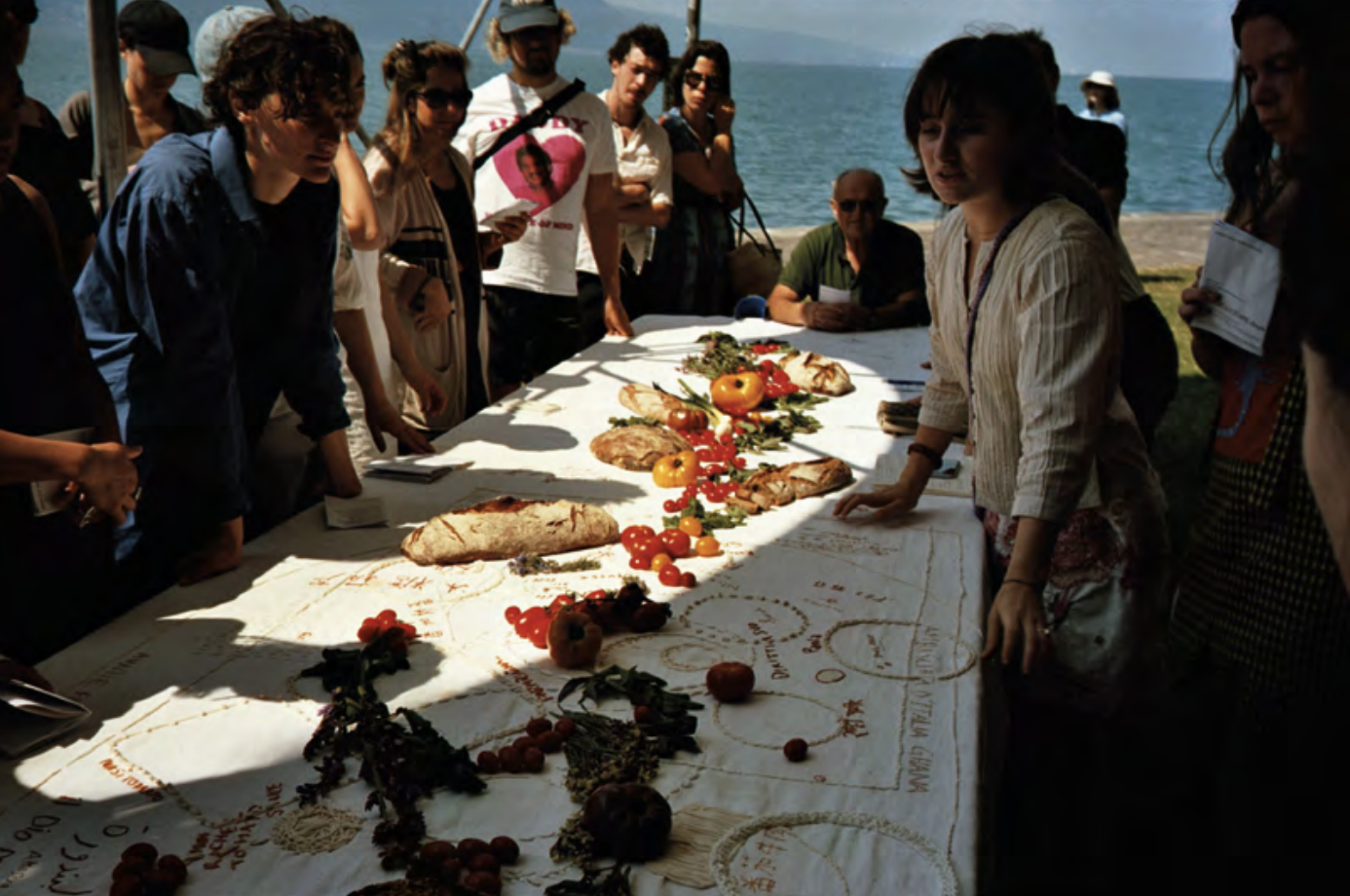
Participatory workshop, where over the preparation of a light meal, participants were invited to embroider on the tablecloth that serves as a map to reveal the multiple realities of tomato production and consumption, in Vevey and beyond.
© Beatrice Zerbato
In May 2022, I visited the association Diritti A Sud (DAS), a migrant farmer solidarity network, legal help desk and independent agroecology farming initiative in Nardò, Puglia. Pao la, Rosa, Musse, Abdullah and myself spent a whole evening together over food. First, we met in the main square for some drinks and lighthearted chats, getting to know each other. Later, we headed to a local restaurant they were familiar with. The owners were extremely welcoming and let me set up my tablecloth, an unusual request which was met with much curiosity and excitement. Thank you Roberto and Carolina for the hospitality.
Speaking to DAS, the racial segregation is obvious. There is a lack of mediation between the migrant communities and Italian society which is aggravating social inequalities and sustaining a gap between what we eat and take pride in, and how it gets on our plates. The palate becomes just another site of bordering². While we prepare food at home, if we remain un-attuned to the violence embedded in food production, then we are just reproducing that violence and hostile
environment from within our most intimate refuge: the home.
In line with feminist tradition, the starting point of my reflections is from the domestic space. After recognizing the pervasiveness of these extractive systems, we can challenge romanticized notions of the home and reclaim its militant potential. Cooking, then, becomes a site of resistance, negotiation and agency. I am not referring to individual consumer choices but to collective action and imagination. As youth we cannot rely on institutional power for change. History shows that meaningful change never came top down but from grass roots movements demanding justice from the bottom up. Transmitting militant memory is crucial to resist the individualist scapegoating that capitalism and neoliberalism impose on us.
The tablecloth has allowed me to create the space to talk about policy by leveling the playing field and inviting people outside of official institutions of decision making. The more it collected signatures, marks and embroideries, the more I noticed its transformation from being a tool for conversation to a collective archive. Threading lines from the domestic to the political, narrating multiple lifeworlds.
Dot by dot
Stitch by stitch
Punto a punto
Draw a line
Hide it
with the needle Flourish waves
around it Blurs
Punto croce, punto erba
Retrace it with the needle
The thread resists
Retrace it, with the
Need to resist
penetrate the horizon
changes
The surface is not flat anymore
It’s soft you push in
It releases
Pressure
While you follow the creases
with your finger
The line rounding
the border disseminates
They don’t exist
They needn’t exist3
In Italy as in much of western media, migration in the Mediterranean is portrayed as a threat to the border. The verbal and visual language of illegality, border enforcement and surveillance technologies work to dehumanize and sensationalise the lives of people on the move. This strategy success fully portrays migration out of context, generating a climate of fear and pity rather than mobilizing solidarity. Harvesting consensus for the violence of the border. However, border violence is structural and policies form the administrative architecture of exclusion that encompass the spaces that lead to the border and beyond. This current relationship of Europe
to its borders is consuming our democratic fabric.
“I find it quite pleasant to pass from one atmosphere to another through crossing a border. […] Borders must be permeable; they must not be weapons against migration or immigration processes.” ⁴
Philosopher Éduard Glissant offers us a potential avenue. For borders to be permeable, we must dismantle, rethink and reconfigure not only their physical state, but also imagine alternative modalities of cross-border relation that oppose the aforementioned administrative framework that perpetrates the border’s violence beyond its fictitious line.
During the various gatherings that made this research, we experimented discussing policies over the tablecloth, using the embroideries from past encounters as the starting point of each meeting. The materiality of the tablecloth and the practice of embroidery, allowed me to uphold the right to opacity in the process of archiving testimonies. The tablecloth interrupts regimes of audibility and provides us the opportunity to forge alternative understandings of ourselves that defy the dominant narratives around borders, migration and the origin of foods through Relation. This methodology draws from Glissant’s concept of Relation and Opacity, where multicultural interaction should allow for opacity and illegibility in order to counter the appropriation and duality of wanting to ‘comprendre’ (french for ‘understand’, whose etymological translation is to ‘take with’). Instead his idea allows for a relation that assembles dissimilarities and challenges western oppositional discourse that insists on transparency as a condition for understanding the Other. People on the move are constantly requested to make their story ‘palatable’, opacity resists this demand.
The very first gathering around the tablecloth actually happened prior to my visit in Puglia. I organized a dinner in London for my Masters unit friends to explore the cultural hegemony of the Italian canned tomato. The invitation entailed bringing a tomato based recipe from their home. The event is now archived on the tablecloth as the first layer of pomo d’orographies, mapping staple tomato recipes across cultures and familial traditions, from Ghanaian tomato and pepper dips, South African bunny-chow, Chinese tomato egg, Malay nasi tomato, Italian Parmigiana etc. This first layer of inscriptions expose the reach of colonial routes and reveals how people are not passive agents of these historical processes.
A month later, with the same research group we travelled to Ghana. The field trip was organized by our academic tutor Dele, who at the time was based in Accra, making our stay rich with encounters. During our stay we had the chance to engage with Ramsey, a local farmer who hosted us for two days. Ramsey talked me through the various market pressures local people face, from imports of fresh tomatoes from neighboring countries to the omnipresence of canned products from Italy and China. As well as the agronomic difficulties due to increased droughts in the north of the country. Many tomato farmers in fact abandon their fields because selling their produce has become financially unsustainable, where most of the farming is done by women and the men are then the ones migrating to Europe as a result of this economic violence. A similar issue independent farmers around the world are facing due to neo-liberal market competition. The hypocrisy of the current economic model can also be summarized in the fact that often leaving the tomatoes to rot on the fields is cheaper than harvesting them, a similar survival practice I was told about by Sicilian farmers.
The next day, while on a bus drive back from our visit to Cape Coast ‘slave castle’ (the logistical infrastructures that operated the trans-atlantic slave trade) to Accra, Ramsey spotted an old lady selling the local variety of tomato on the side of the road, we abruptly stopped the bus, taken by the excitement and went to her stand. We were in a rural area but Italian Salsa and Gino (a Chinese canned product marketed as Italian) were still present at her small stand. I bought a bunch and we started tasting a few. The seller, Auntie Araba, told us the seed had been transmitted within her community for generations. Her ntoosi (Twi for tomato) were small akin to cherry tomatoes but ribbed like the ‘costelluto’ heirloom varieties I am familiar with back home. I like to believe that this smaller and sweeter tomato was probably the closest to the first colonial tomato imports. Ramsey showed me how to extract seeds, one needs to take out as many as possible to increase the chances of propagation, then place them under the sun on a paper towel. Once dry I carefully stored them between the pages of my notebook. Later that spring I replanted them with my aunt and her neighbour to eat in August.
Mid-week in Accra, thanks to my friend Lauren-Loïs and her aunts to whom I am immensely grateful, we cooked Jollof rice to discuss the recipe. Lauren, her auntie and my self left the rest of the group early to go food shopping at the market. As expected, the city market only had imported fresh tomatoes, the local vendor told us came from Burkina Faso and the usual Italian canned products. We bought some Salsa and the rest of the ingredients and headed back to the house. In the kitchen, we got to work taking instructions from the aunties immersed in the chatty atmosphere of it all. I asked auntie Felicia about the various ingredients of Jollofrice, if and when Italian tomato concentrate started becoming an indispensable component. Indeed, she told me that it was not always part of the recipe but more of a new addition from the past two decades. In fact, Italian canned tomatoes started appearing in West African markets in the year 2000s with the introduction of the Economic Partnerships Agreements of free trade between EU and West African countries. The lunch was delicious and while I was flavoring each bite, I thought of how we could mobilize the idea that recipes are the domestic blueprints of global trade policies.
At the end of the week in Ghana we organized a gathering inviting all the people we met in the previous days to share our research in an informal ‘crit’ day. I unfolded the tablecloth and used it as my material to speak from. The feedback that most struck me was an anecdote from one of our guests.
The vicious cycle is so well-known to Ghanaians that it has been summarized in a local banter whereby local tomato farmers abandon their own farm to pick the tomatoes that had driven their own tomato prices down in Italy. It becomes apparent that our current legal regimes are biassed, as they punish people on the move for what our economic policies create in the first place. The concept of illegality and that rights come by entitlement are in deep contradiction to universal human rights and democratic values.
To conclude this thread of thoughts, the most meaningful inscription on my tablecloth is what Musse wrote while in Puglia. ‘Il diritto vale per tutti’, rights apply to everyone, recalling his words, the right to dignity, work and housing belong to all. While I progress on embroidering the various signatures awaiting their turn, the tablecloth now tells its own story and reminds us that democracy needs constant stitching to be kept alive.
- Pablo Neruda, Odas Elementales, extract from ‘Oda al Tomate’, Editorial Losada, 1954
- Bordering is an active process of differentiation and exclusion, shaping territories, identities, and mobilities through both visible and invisible mechanisms (LIMINAL, About, University of Bologna’s Department of the Arts, accessed [2/9/2025], https://liminal-lab.org/about).
- Francesca Paola Beltrame, Raqam Mediterraneo, 2024
- Édouard Glissant: One World in Relation, dir. Manthia Diawara, French with English subtitles, 48 minutes (K’a Yéléma Productions, 2009).